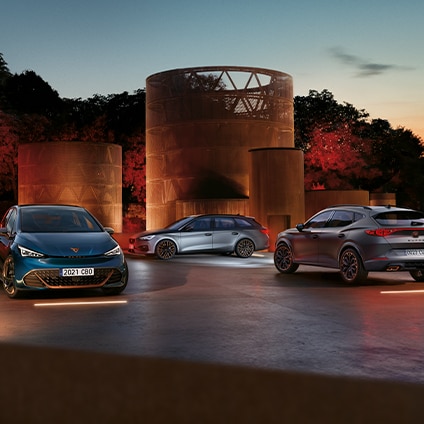
The CUPRA Born is available now. For more info, you can find a dealer here.
Just like combustion vehicles, the consumption (and, as a consequence, the range) of an electric vehicle will change depending on the use and orography of the land. If the use is 100% urban, the range after a full charge will be greater, as a lot of energy is restored while braking. On the other hand, if the use is 100% on highways, the autonomy will be less, as electric vehicles consume more energy on higher velocities. This range can also change depending on the weather.
The biggest difference is in the consumption. The cost of electricity is usually cheaper than fuel or diesel. Thanks to this, we can drive 100km for as little as 1€ (depending on the country). Additionally, an electric vehicle has much fewer maintenance costs than a combustion one as it has sturdier parts and they are fewer too, meaning there is less wear and tear on them.
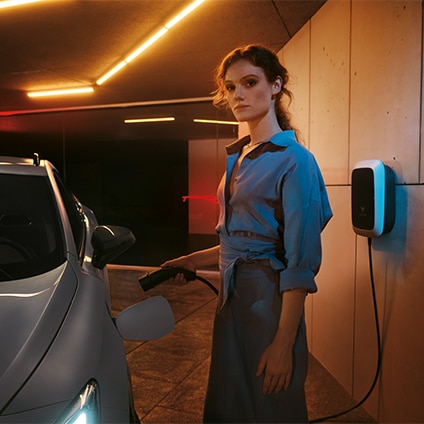
You can charge the new CUPRA Born at home, on the road, or at your destination. Charge up at home with a conventional plug or with a CUPRA charger. If you want to charge your CUPRA Born on the road, you can use the Easy Charging App, which will help you find and navigate to your nearest charging point. You can even use the app to filter through charging points by availability, charging speed and plug type.
Depending on the charge type, it can take from a few minutes to some hours to charge the CUPRA Born. You can charge it to 100km in 7 minutes, which is about the same time it takes to have a coffee.
Yes, we offer solutions for you to charge both at home and on the road. You will find our CUPRA charger with its installation offer on the CUPRA website.
The new CUPRA Born has a length of 4,322mm, a width of 1,809mm and a height of 1,540mm. It also has a boot capacity of 385 litres. For more info you can check the CUPRA Born Technical Specifications inside the specifications section.
The e-Boost pack offers up to +20kW of additional power just by pushing the right (satellite) button on the steering wheel. This translates to better acceleration and dynamism. Apart from the steering wheel with satellite buttons, the pack also includes improved front disc brakes and 19'' Aero wheels.
Going electric means looking ahead. A more eco-friendly, comfortable way to get around with many other advantages.
You can power up your electric car at home, at your destination or during your trip.
Our electric cars allow you to travel hundreds of kilometres on a single charge (the new CUPRA Born has a range of up to 548km*), so when considering that the average distance driven per day by EU drivers is 60km, the CUPRA Born certainly does not need recharging on a daily basis. At an average of 60km a day you would need to recharge the CUPRA Born every 9 days. Also, if you are doing your driving within the city remember that the range increases, so you would need to recharge less frequently
*WLTP range of up to 548 km with combined city & roadway driving.
Thanks to the increased sustainability offered by BEV vehicles, and the reduced environmental impact which they have, many governments have started to promote their usage by creating various subsidies for electric car users. These subsidies often come in the form of TAX exemptions and other associated economic benefits such as free access on toll roads or free parking spaces etc.
Many cities are creating restricted zones to limit, or in some cases prohibit, combustion vehicles from entering. In such zones the use of a fully electric vehicle (like the CUPRA Born) can drive freely as they emit zero CO2 emissions and do not contribute to air contamination within the city.
Charging times may vary, depending on factors such as the outside temperature, the current temperature of the battery, the charging equipment, the condition of the battery and the condition of the vehicle. Specific charging times are detailed in the technical specifications for each available plug-in hybrid model.
8 years or 160,000 km, whichever comes first.
An external factor essential to the performance and capacity of a battery is temperature. For this reason, especially in winter, it is necessary to "precondition" the vehicle during the charging process, that is, to warm up the battery and the interior. Or cool them in summer. This way you will not only save energy to use during driving, but you will also gain extra efficiency right from the start, with a battery at optimal temperature. Furthermore, optimized operating strategies in your vehicle minimize the effects of temperature as much as possible. In addition to the temperature, the range also depends on user-related factors: use of air conditioning, load weight and driving style etc.
Click here for all our CUPRA CONNECT GEN3 FAQs and discover everything you need to know.
Click here for all our CUPRA CONNECT GEN4 FAQs and discover everything you need to know.
You can contact our distributors on the following link: https://vwgroupmotorsport-onlineplatform.com/partners
The CUPRA Leon Competición can compete in all TCR championships (sprint and endurance races). You can get more information of the championship on the following link: https://www.tcr-series.com/
At the end of a PCP contract, there are three options:
1. Part-exchange the vehicle for another vehicle of your choice;
2. Keep the current vehicle – pay the final instalment plus the ‘option to purchase fee’ and the car then belongs to you. Alternatively you can speak with a Volkswagen Financial Services Ireland customer care representative about options to extend the current finance agreement and repay the remaining amount (GMFV) over an agreed period;
3. Return the vehicle to the dealer with no further repayments.
Volkswagen Financial Services Ireland guarantees the minimum future value at the end of the agreement so both you and the dealer are protected. Any shortfall is covered by Volkswagen Financial Services Ireland. As previously referred to, this is subject to the condition of the vehicle and the annual mileage.
At the end of your agreement if you choose to sell your car either to a dealership or privately, the difference between the sale price of the vehicle and the agreed GMFV is known as your equity.
For example:
GMFV = €10,000
Sale Price = €12,000
Equity = €2,000
You can choose to exchange the vehicle, or use the equity, as part of the deposit for a new vehicle.
Learn more about equity here.
Our PCP product is based on the future value of the vehicle. That value is determined by the wear and tear on the vehicle and calculated on the basis of a maximum mileage (or kilometre) usage. As part of the end of contract conditions, an excess charge applies where that usage is exceeded but only if you wish to handback the vehicle to Volkswagen Financial Services and not in cases when you wish to avail of the option to sell or trade in the vehicle. The excess mileage (kilometre) charges vary from brand to brand however the average charge is 6 cent per km.
As with all forms of Hire Purchase, until the final payment is made in settlement of the PCP agreement, the car is legally owned by Volkswagen Financial Services Ireland (although it is registered in you, the customer’s name).
It is important that we highlight a few distinctions.
(a) Volkswagen Financial Services Ireland is a wholly owned subsidary of Volkswagen Financial Services AG.
(b) The PCP product, which is a form of Hire Purchase Agreement, is primarily regulated under the Consumer Credit Act 1995.
(c) Dealers are authorised as intermediaries by the Competition and Consumer Protection Commission.
In addition to the regulations referred to above, the rights and protections for consumers in respect of PCP are provided for within other regulations such as general contract and provision of services law, data protection and e-privacy law among others.
Until now, leasing has been just for businesses but now it’s available for everyone.
That means you have the opportunity to drive any Volkswagen, Audi, SEAT, SKODA, or CUPRA tailored to your taste, with no upfront cost for just one easy monthly payment.
As with all forms of Hire Purchase, until the final payment is made in settlement of the PCP agreement, the car is legally owned by Volkswagen Financial Services Ireland (although it is registered in you, the customer’s name).
Ownership is retained by VWFS. Therefore, the risks remain with VWFS and there are no residual issues for you.
Your term can be anywhere from 12 - 48 months. It can be specific monthly intervals ie. 35, 36, 37 months.
In your Personal Leasing contract road tax is included and you have the option to add all your servicing and maintenance costs too:
Personal Leasing includes a fixed monthly rental payment so you know the cost from the start.
Your fixed monthly rental payment is due on the 1st or 15th of each month.
You activate your Personal Leasing contract with your preferred Dealership.
When you’re leasing directly from your Dealership, you benefit from that expertise and a level of service that is second to none.
Then at the end of your contract term, you can renew your contract at the Dealership.
The mileage range is 5km - 40km annually across vehicle types and fuel types (excludes electric vehicles).
You have Unlimited Contract Modifications (up to 6 months before end of contract)
Yes, there's no restriction on what model or spec you decide to choose. Personalise your plan by agreeing the repayment period and annual mileage that suits you. All your costs included in one fixed monthly payment.
With Personal Leasing, there is no upfront cost required. Your monthly payment can be all inclusive, leaving you worry free. To manage your monthly rental you may at the start of your contract include up to 10% of the RRP, to reduce your monthly rental.
Smart charging refers to a charging system that optimises charging through data connections. Our smart chargers can stop and start charging to align with periods of low demand on the grid, when prices are generally lower. This not only saves you money but also helps balance the grid.
Save money:If you have a time-of-use tariff or a variable tariff, you’ll pay less for your electricity at certain times of the day. The Ohme app uses your tariff information to charge as much as possible when the price is low to maximise your savings.
Remote management:With the Ohme app, you can control your charging at the click of a button. You can schedule charge sessions, apply a price cap to limit your charging to a certain price/kWh, and keep an eye on your energy costs & consumption.
Grid balancing:The Ohme charger can adjust energy intake according to peaks and lows in electricity demand which allows for load balancing and peak shaving. Put simply, peak shaving refers to managing consumer demand to eliminate demand spikes (high peaks) which in turn puts less pressure on the grid. This is often done through energy suppliers offering cheaper electricity during off-peak hours.
You’ll need to create a schedule that specifies the percentage you would like to add to the current amount of charge displayed in your car.
For example, if you normally return home with 30% charge left in your EV and you want to have 80% ready for the next morning, you’ll need to create a schedule to add 50% more charge (30% + 50% = 80%).
If you create a schedule asking Ohme to add charge more than 100%, you might receive an alert to tell you that your car isn't charging as expected. This isn't anything to worry about, but it's our way of letting you know that we were expecting to deliver more charge.
If you have any issues, or you’re worried something isn’t quite right, our Customer Care team are happy to help.
There are a number of things that can affect how long it takes to fully charge your EV. The charge point directly affects the rate at which your car charges as it will have a maximum charge rate it can deliver. The time it takes to charge is also affected by car battery size, battery state of charge, and environment (such as how cold it is outside). This might all be new to you, but we’ll explain a little bit more about how these factors impact how long it takes to fill your battery.
Battery Size: Some cars have larger batteries than others, and these will take longer to fully charge. If you have a plug-in hybrid with a smaller battery, you’ll notice this take much less time to full charge than a fully electric car.
Maximum charge rate of vehicle: Your EV will have a maximum charge rate which effects how quickly the battery can accept charge. If your car has a maximum charge rate of 7kWh, this means it’ll only be able to consume 7 kilowatts of energy every hour. You can use your car’s maximum charge rate and battery size to work out how long it may take to fully charge.
Maximum charge rate of charge point: Each charge point has a maximum charge rate, which may differ from the max charge rate of your car. Your car may have a maximum charge rate of 7kWh, but you’ll notice the car charges much more slowly when plugged into a 3-pin charger with a max charge rate of 2.4kWh.
Temperature: Colder temperatures can cause longer charging times, but you’ll probably only notice this when rapid charging. A cold battery will take a little longer to ramp up to 200kWh, but shouldn’t have any trouble charging at 7kWh in colder weather.
State of battery: The closer your battery is to empty, the longer it will take to charge. Make sure you allow plenty of time to charge if your battery is particularly low.